In this revision we have added the anatomy of the labia minora, complication figures taken from reviews of the literature and a section on when it is better to wait before a correction. Following Dr Maggi's review, we have added the illustrated timeline and guidance on hygiene, driving and sensation, and clarified when physical activity can be resumed.
In brief. After labiaplasty, swelling peaks in the first 2-3 days. Desk work is usually resumed after 3-5 days; after 2-3 weeks some light physical activities can be gradually resumed, while intensive training, cycling and horse riding call for more caution; sexual intercourse usually after 4-6 weeks, once the wound is well closed. The result is assessed at 3-6 months, sometimes later: in the first weeks the swelling often differs between the two sides. Among the complications reported in studies, one of the most common is partial reopening of the wound, around 6% in the 2024 meta-analysis. If a correction is needed, it is done once the tissues have matured.
The timings you find here are the ones I give at the consultation, but they are approximate: everyone heals in their own way, and I always confirm them at the check-ups. Knowing them in advance is useful above all for one thing: planning work, children, sport, a holiday already booked.
Why the labia minora swell so much
The labia minora are two thin folds of skin and mucosa, with no fatty tissue, that surround the vestibule, the area where the urethra and the vagina open. At the top they join the clitoral hood. Shape, length, colour and symmetry vary a great deal from woman to woman, and labia minora that protrude beyond the labia majora are a normal variant: I discuss this in the article on the shapes and sizes of a normal vulva.
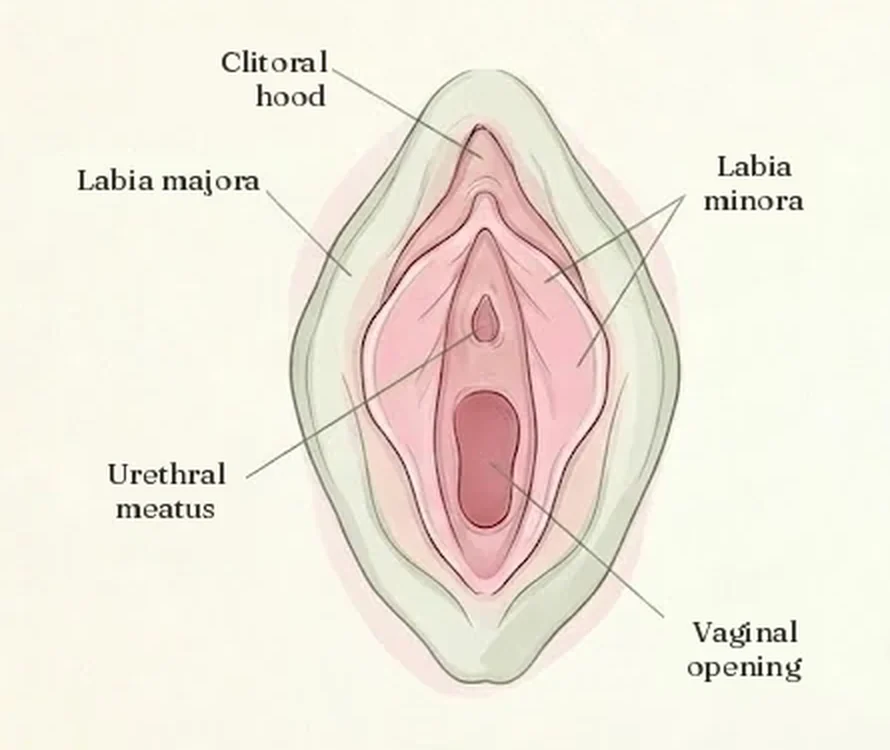
The labia minora are made of thin tissues with a rich blood supply and no fatty tissue. After the operation, the inflammatory response, the temporary increase in the permeability of small vessels and changes in local drainage encourage oedema to develop. The swelling can be considerable and is not necessarily symmetrical.
How long does swelling last after labiaplasty?
Swelling is generally most intense in the first 2–3 days, then decreases gradually over the following weeks. It can be asymmetrical and is not necessarily a complication. Swelling that is sudden, very painful or rapidly increasing, on the other hand, requires a medical assessment.
Knowing how the blood supply reaches the tissue matters above all to the surgeon. An anatomical study on 11 cadavers described a dominant central artery, two posterior arteries and a small anterior artery, connected to one another[5]. During the resection, an adequate blood supply to the remaining flaps must be preserved, because healing of the suture depends on it.
The distribution of the vessels also matters when choosing the technique. In the wedge technique (wedge) a triangle of tissue is removed from the central part and the two flaps are brought together, preserving the natural edge[6]; in the trim technique a strip is removed along the margin. At least eight techniques are described in the literature, all with good results and none better in absolute terms[4]. In the wedge technique the suture crosses the labium, and if the flaps receive less blood or are under tension the wound heals less well: this is one of the explanations proposed for the slightly higher risk of reopening reported with this technique[1],[5].

The day of the operation
Labiaplasty usually takes about an hour, longer if combined with other procedures such as clitoral hood reduction (not to be confused with clitoropexy, which repositions the clitoris and is a different operation). I perform it under local anaesthesia with sedation, so you feel no pain and you are relaxed. You go home the same day, accompanied: you must not drive on the day of sedation (I discuss this further on, in the section on driving).
During labiaplasty I use a radiofrequency instrument that makes it possible to cut the tissues and, at the same time, achieve haemostasis of the small vessels. Some studies on techniques using energy-based devices have reported favourable results for bleeding control[1], but the evidence specific to radiofrequency in labiaplasty is still limited. It is therefore not possible to attribute to it, with certainty, a lower complication rate than other techniques.
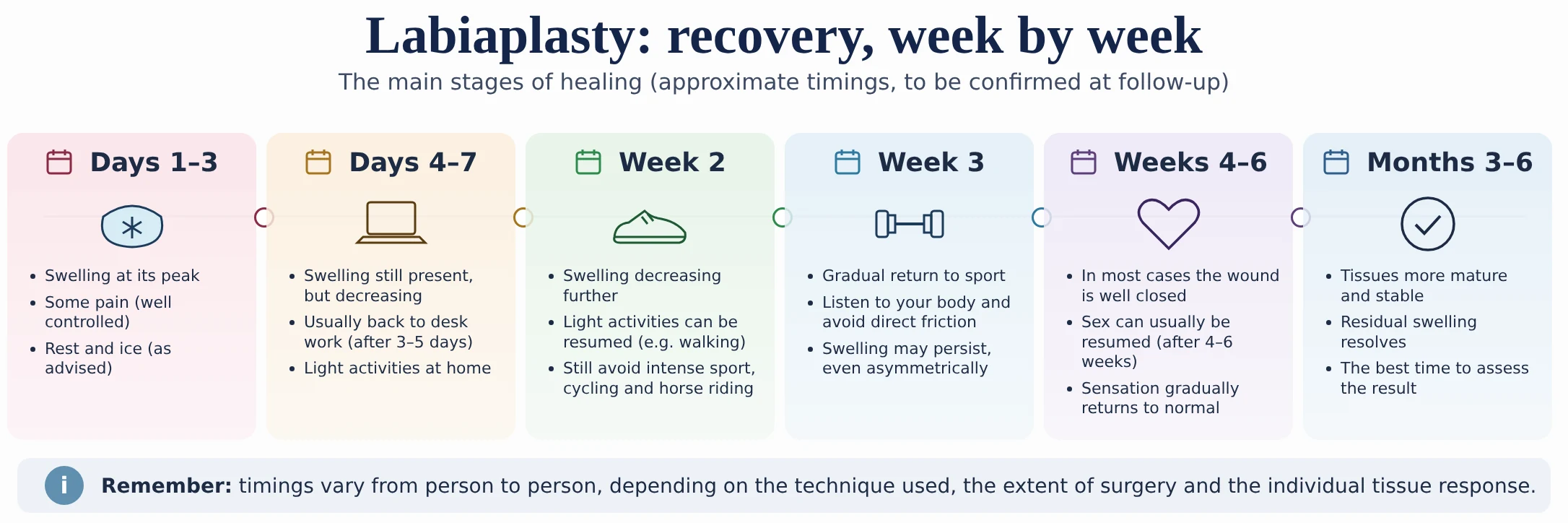
The stages of recovery
-
First 2-3 days
Swelling is at its peak
- Discomfort and a feeling of tightness, manageable with the painkillers I prescribe.
- Rest, soft cotton underwear that is not tight, cold packs wrapped in a cloth, never in direct contact with the skin.
- A little bleeding on the dressing is normal.
-
From day 3 to day 5
Back to light activities
- Desk work and short trips.
- Sitting for a long time can be uncomfortable: getting up every so often helps.
- Gentle hygiene, following the written instructions I give you after the operation.
-
Second week
Swelling goes down, the wound closes
- Discomfort decreases day by day.
- Itching and altered sensation are common: they are part of healing.
- First check-up, to look at the wound and answer your questions.
-
After 2-3 weeks
Physical activity
- It may be possible to gradually resume some light physical activities, if healing is progressing normally.
- Intensive training, running, exercises with friction on the vulval area, cycling and horse riding call for more caution: we decide together at the check-up when to start again.
-
After 4-6 weeks
Sexual intercourse
- When the wound is well closed and the swelling has gone down.
- Gently the first few times: slightly different sensation in the first weeks is common and usually settles.
-
After 3-6 months
When to assess the stabilised result
- The tissues have generally become much more stable and most of the swelling has gradually resolved.
- This is the usual time to judge shape and symmetry, although some aspects of the scar may continue to change beyond six months.
| When | What usually happens | What you can do |
|---|---|---|
| First 2-3 days | Peak swelling, tightness, slight bleeding | Rest, cold packs wrapped in a cloth, the prescribed painkillers |
| 3-5 days | Discomfort eases; sitting for long periods can be tiring | Desk work and short trips |
| Second week | The wound closes; itching and altered sensation | First check-up |
| 2-3 weeks | Swelling clearly going down | Gradual return to light physical activities; intensive training, running, cycling and horse riding after an individual assessment |
| 4-6 weeks | Wound well closed | Sexual intercourse, gently |
| 3-6 months | Much more stable tissues, softer scar | Assessment of the stabilised result, sometimes later |
Physical activity: it is not just about the calendar
After 2–3 weeks it may be possible to gradually resume some light physical activities, provided healing is progressing normally. Intensive training, running, exercises with friction on the vulval area, cycling and horse riding call for greater caution and an individual assessment. Resuming does not depend only on the number of days that have passed, but above all on wound closure, the presence of swelling and the absence of pain.
How long does it take to heal completely?
Superficial healing generally takes a few weeks, while the gradual settling of the tissues and the scar continues for several months. The aesthetic result is usually assessed after 3–6 months, sometimes later.
What is normal and when to call me
Usually normal
- Swelling, even if asymmetrical
- Bruising
- Slight bleeding in the first few days
- Itching during healing
- Sensation different from usual
Call me straight away if
- The bleeding does not stop
- One side suddenly swells, with severe pain
- You have a fever
- You notice unpleasant-smelling discharge
- The wound opens
Sudden, painful swelling on one side only can be a sign of a haematoma, a collection of blood under the skin; fever and foul-smelling discharge can indicate an infection. These events are uncommon, but they need to be seen early.
Hygiene after the operation
After the operation I give you written instructions, and those are the ones that apply in your case. The general principles are simple:
- Gentle cleansing of the area, without rubbing.
- Drying without friction, by patting.
- No irritating products: no harsh soaps, perfumes or products that have not been prescribed.
- Following your individual instructions, which may vary with the technique and with how healing progresses.
When to drive again
You must not drive on the day of sedation. To drive again you need to be fully alert, free of sedative medication and able to carry out every manoeuvre, including an emergency stop, without pain that limits you. There is no single day that applies to everyone: if in doubt, we discuss it at the check-up.
How sensation changes
In the first weeks it is common for sensation in the area to change: some patients notice temporary hypersensitivity, others hypoaesthesia, meaning reduced sensation. These are usually transient and improve as the swelling goes down and the scar matures.
Symptoms that persist, that get worse over time instead of easing, or that are particularly painful are a different matter: in these cases a reassessment is needed, without waiting for the next check-up.
Risks and complications, with figures
What is the most common complication?
Among the complications reported in studies, one of the most common is dehiscence, meaning partial reopening of the suture. A 2024 meta-analysis reported a pooled rate of around 6%, with differences between techniques and studies[1].
Labiaplasty generally has a low rate of serious complications, but no operation is free of risk. The figures that follow come from reviews of the literature that pool dozens of studies, often small, retrospective and with different definitions of complications: they should be read as orders of magnitude, not as your exact probability.
The wound that reopens (dehiscence)
Partial reopening of the suture, medically called wound dehiscence, is the most common complication. In the largest meta-analysis available, 53 studies and almost 4,000 patients, it affects on average about 6% of patients and about 8% with the wedge technique[1]. Other reviews report different values: 4.7% in a review of 19 studies[3], 3% for the wedge technique in another meta-analysis of 46 studies[2]. In a direct comparison of 64 patients, dehiscence was the main complication, with a tendency to be more frequent with the wedge technique, but without a statistically significant difference[7]. The differences between the meta-analyses depend on which studies they include and on how they define dehiscence: they do not show that one technique is superior to another.
A small, superficial reopening of the wound does not necessarily require a new operation and can heal with appropriate dressings. However, any dehiscence must be reported to the surgeon and assessed. If the reopening is extensive, or is accompanied by heavy bleeding, severe pain or signs of infection, an urgent assessment is needed. Sometimes, once healed, the wound leaves a small defect, which can be corrected with a revision. I say this before the operation, not after: surgery is not an exact science, and 1 + 1 does not always make 2.
Other complications
- Haematoma and bleeding: in the largest meta-analysis, about 3% and 2% of patients, less frequent with energy-based instruments[1].
- Infection: about 3%[1]; it is usually treated with antibiotics.
- Marked swelling, recorded as a complication: about 4% in the same analysis, more frequent with combined reduction of the labia minora and the clitoral hood[1].
- Asymmetry or an irregular edge: possible even when the wound heals well; sometimes they can be corrected with a touch-up.
- Over-correction, meaning the removal of too much tissue: it is the hardest complication to correct. A German surgeon who has performed corrective operations on about 4,300 women, mostly after reductions carried out elsewhere, describes reconstructing labia minora that have been shortened too much as often difficult and not always satisfactory[10]. This is a selected series of patients who sought a correction: it does not allow us to estimate how often over-correction occurs among all women who have the operation. That is why I prefer a conservative approach.
- Altered sensation and pain during intercourse: usually temporary; persistent cases are rare. The American College of Obstetricians and Gynecologists (ACOG) lists them among the complications patients must be told about, together with scarring, adhesions and the need for further surgery[12].
- Scars: usually not very visible because they blend into the natural folds, but always present.
Overall, the largest meta-analysis reports complications in about 9% of patients[1]. In the 2024 meta-analysis pooled satisfaction was around 94%. This is a favourable figure, but it comes from studies with different methodologies and follow-up times. It does not mean that every patient has the same probability of being satisfied, nor that functional problems or unwanted changes in sensation are ruled out. In one of the largest historical case series, too, 163 patients, 4% of those who answered the questionnaire would not have the operation again[8]. In an Australian prospective study, 29 women followed for 6 months, 83% said they were moderately or very satisfied with the overall result; the operation improved satisfaction with genital appearance but did not change general psychological well-being, and high psychological distress before surgery was associated with lower satisfaction[11].
What we know and what we do not know
Some points are fairly solid: in every review, reopening of the wound is among the most common complications, serious complications are uncommon and the satisfaction reported in studies is generally high. Others remain uncertain. Most studies are small and retrospective, with different definitions of complications and short follow-up; comparisons between techniques and instruments are few and almost never direct; we do not know how often over-correction occurs among all women operated on, nor do we have solid data on long-term sensation. The recovery timings in this article do not come from controlled studies either: they are those of my clinical practice, and that is why I confirm them at the check-ups.
When to wait: revision and who should not have surgery
Before a revision, we wait
If the wound reopens or you are not happy with the result, the temptation to correct it straight away is understandable. A revision, however, is not done soon after the first operation: we wait for the swelling to disappear and for the tissues to mature, because operating on tissue that is still inflamed gives worse results and makes it hard to see how much tissue is really there. Many small defects improve on their own in the meantime. In one case series, scar corrections were performed 7 and 10 months after the first operation[9]; we decide the right time together at the check-ups.
In the second meta-analysis, the most common reasons for revision were dehiscence and aesthetic concerns[2].
When not to operate, or to postpone
- Infections or irritation of the genital area that are still active: they are treated first.
- No real discomfort, physical or psychological, felt by you: the appearance of the labia minora varies a great deal, and a difference is not in itself a reason to operate.
- A request that comes from pressure by others, by a partner or by images seen online.
- Significant psychological distress related to body image: ACOG recommends recognising it and, if it is suspected, offering an evaluation before surgery is considered[12].
- Under 18: ACOG encourages reassuring girls about the normal variability of anatomy, offering non-surgical measures first and explaining that the labia may continue to grow and that symmetry is not guaranteed[13].
Some practical tips
- Plan the first days in advance: someone to take you home and, if you have young children, help for a few days.
- Keep to hand soft cotton underwear, sanitary pads and comfortable trousers.
- Avoid baths, swimming pools and the sea until the wound is completely closed: I will confirm this at the check-up.
- Follow the written instructions I give you, and write to me with any doubt: I would rather have one question too many than a problem discovered late.
All of this is discussed at the first consultation, together with techniques, risks and limits, so that you can decide calmly and knowing what to expect. You will find it in the complete guide to labiaplasty.
Frequently asked questions
How many days after labiaplasty can you go back to work?
For desk work, usually after 3-5 days. If your job involves standing a lot or physical effort, a few more days may be needed: we discuss it before the operation, so you can plan.
When can sexual intercourse be resumed?
Usually after 4-6 weeks, when the wound is well closed and the swelling has gone down. I confirm it at the check-up, looking at how healing is progressing.
Is it normal for one side to be more swollen than the other?
Yes, it is common in the first weeks. Swelling is rarely the same on both sides and can make the result look asymmetrical. That is why the result is not judged before 3-6 months. If, on the other hand, one side suddenly swells with severe pain, call me straight away.
When can I go back to cycling or horse riding?
After 2-3 weeks it may be possible to gradually resume some light physical activities. Cycling and horse riding, like intensive training and running, call for greater caution and an individual assessment: we decide together at the check-up when to start again, based on wound closure, swelling and the absence of pain.
If the wound reopens, will I need another operation?
A small, superficial reopening of the wound does not necessarily require a new operation and can heal with appropriate dressings. However, any dehiscence must be reported to the surgeon and assessed. If the reopening is extensive, or is accompanied by heavy bleeding, severe pain or signs of infection, an urgent assessment is needed. If a defect remains after healing, a revision is planned once the tissues have matured, usually several months later.
When can the result be assessed?
Usually after 3-6 months, sometimes later, when the tissues have generally become much more stable. Most of the swelling resolves gradually, but some aspects of the scar may continue to change beyond six months.
«Prima comprendere» ("Understand first")
The weeks after labiaplasty test your patience more than anything else. A woman who looks in the mirror on day five sees swollen tissue, sometimes lopsided, and wonders whether everything went well. Almost always the answer is yes, but you have to wait to see it.
That is why I prefer to explain the recovery beforehand, not afterwards: knowing that the swelling is uneven, that a small reopening can happen and that the result is judged months later takes away a lot of anxiety. If you are considering this operation, the first consultation is there to understand whether it is really right for you and how to organise the weeks that follow.
Annotated bibliography
-
Systematic review and meta-analysis
Géczi AM, Varga T, Vajna R, Pataki G, et al. – Comprehensive Assessment of Labiaplasty Techniques and Tools, Satisfaction Rates, and Risk Factors: A Systematic Review and Meta-analysis
Source: Aesthetic Surgery Journal, 2024;44(11):NP798–NP808 – doi:10.1093/asj/sjae143
What it covers: 53 studies, 3,954 patients: overall satisfaction 94.4%, complications in 8.9%; dehiscence in 5.9% on average and in 8.4% with the wedge technique; haematoma 3.3%, bleeding 2.2%, infection 3.0%; with the laser, fewer haematomas and less bleeding than with the scalpel.
Why it matters: It is the largest synthesis available and the main source of the figures in this article. Most of the included studies are small and retrospective, and it does not report revision rates.
-
Systematic review and meta-analysis
Escandón JM, Duarte-Bateman D, Bustos VP, Escandón L, et al. – Maximizing Safety and Optimizing Outcomes of Labiaplasty: A Systematic Review and Meta-Analysis
Source: Plastic and Reconstructive Surgery, 2022;150(4):776e–788e – doi:10.1097/PRS.0000000000009552
What it covers: 46 studies, 3,804 patients: pooled satisfaction 99%; the highest dehiscence rates with laser labiaplasty (5%) and with the wedge technique (3%); 169 revisions, mainly for dehiscence and aesthetic concerns.
Why it matters: It reports dehiscence and satisfaction rates that differ from those of the 2024 meta-analysis: the values depend on which studies are included and on how a complication is defined. The difference between the two analyses should not be read as proof that one technique is superior to another.
-
Systematic review
Motakef S, Rodriguez-Feliz J, Chung MT, Ingargiola MJ, Wong VW, Patel A – Vaginal labiaplasty: current practices and a simplified classification system for labial protrusion
Source: Plastic and Reconstructive Surgery, 2015;135(3):774–788 – doi:10.1097/PRS.0000000000001000
What it covers: 19 studies, 1,949 patients, seven techniques: satisfaction between 94% and 100%; the most common complication is wound dehiscence (4.7%).
Why it matters: One of the first systematic reviews on the subject; it also proposes a classification of labia minora protrusion.
-
Literature review
Oranges CM, Sisti A, Sisti G – Labia Minora Reduction Techniques: A Comprehensive Literature Review
Source: Aesthetic Surgery Journal, 2015;35(4):419–431 – doi:10.1093/asj/sjv023
What it covers: 38 studies published between 1971 and 2014, 1,981 patients, eight labia minora reduction techniques: satisfactory results with all of them, few complications and a small number of revisions.
Why it matters: It explains why there is no single best technique and why the recovery and the risks must be tailored to each patient's anatomy.
-
Anatomical cadaver study
Georgiou CA, Benatar M, Dumas P, Chignon-Sicard B, Balaguer T, Padovani B, Baqué P – A Cadaveric Study of the Arterial Blood Supply of the Labia Minora
Source: Plastic and Reconstructive Surgery, 2015;136(1):167–178 – doi:10.1097/PRS.0000000000001394
What it covers: In 11 cadavers it describes the arterial network of the labia minora: a dominant central artery, two posterior arteries and a small anterior artery, with connections between the external and internal pudendal systems.
Why it matters: It helps explain why the labia minora swell so much and why the position of the wedge affects how the suture heals.
-
Technique description
Alter GJ – A New Technique for Aesthetic Labia Minora Reduction
Source: Annals of Plastic Surgery, 1998;40(3):287–290 – doi:10.1097/00000637-199803000-00016
What it covers: The original paper describing central wedge resection, designed to reduce the labia minora while preserving their natural edge and colour; 4 patients, with no complications.
Why it matters: It is the origin of the wedge technique mentioned in the article; the series is tiny and says nothing about how often complications occur.
-
Retrospective comparative study
Ouar N, Guillier D, Moris V, Revol M, Francois C, Cristofari S – Complications postopératoires des nymphoplasties de réduction. Étude comparative rétrospective entre résections longitudinale et cunéiforme
Source: Annales de Chirurgie Plastique Esthétique, 2017 – doi:10.1016/j.anplas.2017.02.005
What it covers: 64 patients operated on at a single centre, 42 with the wedge technique and 22 with edge resection, checked at 1 week, 1 month and 6 months: dehiscence was the main complication, with a tendency to be more frequent with the wedge technique.
Why it matters: It is one of the few direct comparisons between the two techniques. The difference was not statistically significant and some figures in the abstract are inconsistent with one another: I cite it only for its qualitative finding.
-
Retrospective case series
Rouzier R, Louis-Sylvestre C, Paniel BJ, Haddad B – Hypertrophy of labia minora: experience with 163 reductions
Source: American Journal of Obstetrics and Gynecology, 2000;182(1):35–40 – doi:10.1016/s0002-9378(00)70488-1
What it covers: 163 patients operated on over nine years: satisfactory anatomical result in 93% at one month; among the 98 who answered the questionnaire, 83% were satisfied and 4% would not have the operation again.
Why it matters: One of the largest historical case series; it is a reminder that a share of patients, however small, is not satisfied.
-
Retrospective case series
Tremp M, Oranges CM, Schaefer DJ, Waldkircher NJ, Schleh AC, Kalbermatten DF – The Butterfly Technique: A Retrospective Study for Labia Minora Reduction Using an Integrated Approach
Source: Plastic and Reconstructive Surgery Global Open, 2021;9(9):e3810 – doi:10.1097/GOX.0000000000003810
What it covers: 10 patients, 17 labiaplasties with a technique combining de-epithelialisation and a wedge: three patients with wound-healing problems; scar corrections performed at 7 and 10 months; intercourse allowed at 6 weeks.
Why it matters: A small series, useful only as an example of the timing with which corrections are planned.
-
Retrospective study with questionnaire
Gress S – Labia Minora Repair
Source: Aesthetic Plastic Surgery, 2021;45(5):2447–2463 – doi:10.1007/s00266-021-02383-4
What it covers: The author reports corrective operations on about 4,300 women, mostly after reductions performed elsewhere; the most common deformity is excessive removal below the clitoris. Outcomes were assessed with an anonymous questionnaire in 544 patients.
Why it matters: It shows how difficult, and not always satisfactory, it is to reconstruct labia minora that have been shortened too much. It is a selected series of patients who underwent correction: it does not allow the frequency of over-correction among all women operated on to be estimated.
-
Prospective controlled study
Sharp G, Tiggemann M, Mattiske J – Psychological Outcomes of Labiaplasty: A Prospective Study
Source: Plastic and Reconstructive Surgery, 2016;138(6):1202–1209 – doi:10.1097/PRS.0000000000002751
What it covers: 29 women who had surgery and 22 comparison women, followed for 6 months: 82.8% of those operated on were moderately or very satisfied with the overall result; satisfaction with genital appearance improved, general psychological well-being did not; high psychological distress before surgery predicted lower satisfaction.
Why it matters: It is a reminder that results are judged months later and that expectations matter as much as technique.
-
Opinion of a scientific society
Schnatz P, Boardman LA; ACOG Committee on Gynecologic Practice – ACOG Committee Opinion Number 795: Elective Female Genital Cosmetic Surgery
Source: Obstetrics & Gynecology, 2020;135(1):e36–e42 – doi:10.1097/AOG.0000000000003616
What it covers: Patients should be told that high-quality evidence is lacking and be informed about possible complications: pain, bleeding, infection, scarring, adhesions, altered sensation, pain during intercourse and the need for further surgery; it recommends recognising body-image disorders.
Why it matters: It is the reference for truly informed consent and for patient selection.
-
Opinion of a scientific society
American College of Obstetricians and Gynecologists, Committee on Adolescent Health Care – Committee Opinion No. 686: Breast and Labial Surgery in Adolescents
Source: Obstetrics & Gynecology, January 2017 (PMID 28002312) – acog.org · summary: contemporaryobgyn.net
What it covers: For girls under 18 it recommends reassurance about the normal variability of anatomy, trying non-surgical measures first and explaining that symmetry is not guaranteed and that the labia may continue to grow.
Why it matters: It indicates when it is better to wait. The original text, on the ACOG website, was not accessible to our verification tools: its content was checked against a summary published by Contemporary OB/GYN.
Further reading:
Labiaplasty: the complete guide →
Normal vulva: shapes, sizes and variability of the labia minora →
Clitoropexy and the clitoral hood →
Medically reviewed by Dr Giulio Maria Maggi, Plastic Surgeon — last review:
Article written by Dr Giulio Maria Maggi

Aesthetic Plastic Surgeon – Turin, Asti and Alessandria
Medical Director – Aesthetic Clinic (Turin)
Turin Medical Council (Ordine dei Medici di Torino) no. 20595
Member of AICPE – Italian Association of Aesthetic Plastic Surgery
Expertise and areas of interest
Dr Maggi trained internationally, completing advanced training with Prof. José Guerrero Santos (Guadalajara) and with Prof. Andrew A. Jacono (New York) in the Deep Plane facelift technique.
He focuses in particular on:
- Deep Plane facelift
- Blepharoplasty
- Functional and aesthetic intimate surgery
- Liposculpture and fat grafting (lipofilling)
- Breast surgery
- Body contouring
Clinical approach
Combines scientific rigour with natural results, applying advanced protocols focused on morphological well-being.