What hymenoplasty is and what it cannot achieve
Hymenoplasty is a surgical procedure that aims to reconstruct a fold of mucosal tissue in the hymenal region, using the remnants that are present or, in some techniques, small flaps of the surrounding mucosa. It does not restore a biological state of virginity, it does not erase any previous sexual intercourse and it does not guarantee bleeding during a subsequent intercourse.[3],[4],[6]
«Revirginisation» is the word people use most often, but it is not a medical term: in medicine we speak of hymenoplasty or hymen reconstruction. The operation does not create a structure identical to the original hymen and does not resolve the family or social pressure that sometimes lies behind the request.[11] The appearance of the hymen does not make it possible to establish whether a person has had vaginal intercourse.[1],[2]
Anatomy of the hymen: what medicine says
The hymen is a thin fold of mucosa at the entrance to the vagina. Its shape, thickness and elasticity vary greatly from one woman to another and change over time: at puberty, under the effect of oestrogen, it becomes thicker and more elastic.[2]
Minor injuries to the hymen often heal within a few days without leaving any mark, unless the tear is complete. There is no evidence that sport or tampons damage it.[2] Bleeding may occur or may not. Its presence or absence does not make it possible to establish a person's sexual history.
This is why, at the consultation, I describe your tissues to you, what can be reconstructed and with what limits. I do not issue virginity certificates: no examination could provide them reliably.
Why it is requested: autonomy, social pressure and alternatives
For reconstruction requested in order to reproduce a supposed sign of virginity, no clinical benefit has been demonstrated.[11] Operations performed for anatomical conditions, such as an imperforate hymen, have different indications.
The reasons are almost always personal, family-related, cultural or religious, not medical. In some settings virginity before marriage, and the bleeding that is supposed to prove it, are still a strong expectation: a woman who fears not meeting it may fear judgement, exclusion or violence.[9],[12] Sometimes the request follows an experience of sexual violence.[3] I do not judge any of these reasons; my job is to understand yours.
Ethical views differ. Some authors see the operation, in certain settings, as a way of protecting a woman's health and autonomy.[9] Others believe it reinforces the idea that a woman's worth depends on her virginity: in the United Kingdom a government-appointed expert panel concluded that the operation has no medical indication,[11] and since 1 July 2022 it has been a criminal offence.[12] The law differs from country to country and changes over time. Doctors' experience varies too: in a survey of Flemish gynaecologists most had received requests, but specific training was scarce and only a minority discussed alternatives with their patients.[10]
Alternatives deserve time before any decision: not having surgery, talking to someone you trust or, when it is safe for you, to your partner, or turning to a family counselling centre or a psychologist. In a Dutch study, after in-depth counselling and accurate information, about three women in four decided not to have surgery. The study had no comparison group and does not show that the counselling was what changed their choice.[3]
A truly free choice: external pressure and personal safety
During the consultation it is essential to understand whether the request comes from an autonomous decision or from family, relationship or social pressure. The conversation must include a private space with the patient, without anyone accompanying her, in which motivations, expectations, alternatives and possible risks can be discussed freely. If coercion, threats or fears for her own safety emerge, the priority is not to schedule the operation but to find an appropriate pathway of protection and support.[11],[12]
You can come alone or with someone you trust; at least part of the consultation, in any case, takes place just between the two of us. I do not perform the operation on minors. If you need help, in Italy 1522, a free number open 24 hours a day, puts you in touch with anti-violence centres.
Are hymenorrhaphy and hymenoplasty the same thing?
Hymenoplasty is the general term for operations to reconstruct the hymen. The word hymenorrhaphy refers more precisely to stitching the hymenal remnants together, although some publications use the two terms as synonyms. When the remnants are brought together with stitches, this is called repair by suture. Other techniques rebuild a fold using small flaps of vaginal mucosa as well. At the consultation I explain which tissues are present, which procedure would actually be possible and what limits it would have in your case. No technique can guarantee bleeding during a subsequent intercourse.
There is no standard technique, and there are no universally validated protocols that guarantee the result.[5],[8]
1. Suture of the hymenal remnants
Some techniques described in the literature involve bringing the hymenal remnants together with sutures. Feasibility depends on the amount and characteristics of the tissue available. The scientific evidence on how long the results last and how reliable they are is limited; it is therefore not possible to guarantee a given outcome, especially when the operation is scheduled shortly before an expected intercourse.
2. Reconstruction with mucosal flaps
A fold is rebuilt with flaps taken from the remnants of the hymen or, if they are not enough, with small flaps of vaginal mucosa.[5] In the literature this procedure is often called «long-term» reconstruction.
The term «long-term» describes the reconstructive intention and the need to allow complete healing. It does not mean that the reconstructed structure has the same anatomical or functional characteristics as the original hymen, nor that it can be verified as such through an examination.
| Feature | Suture of the hymenal remnants | Reconstruction with mucosal flaps |
|---|---|---|
| What is done | The hymenal remnants are brought together with stitches | A fold is rebuilt with flaps taken from the remnants or from the vaginal mucosa |
| What is needed | Sufficient hymenal remnants | Hymenal remnants or, if scarce, vaginal mucosa |
| What we know | Limited evidence on duration and reliability | Limited evidence; the reconstructed fold is not the same as the original hymen |
What the studies say
The evidence comes mainly from observational studies. Some compare different techniques; results are hard to compare across studies because the procedures, the outcomes measured and the number of patients reached at follow-up all differ.[3],[4],[5],[6] On bleeding the data vary widely: in the Dutch study, 17 of the 19 women who had surgery and were contacted again did not bleed at first intercourse;[3] in a Chinese series, 28 of the 51 patients who reported intercourse had bleeding.[4] In a Turkish comparison, satisfaction with bleeding, which is the patient's own judgement, was higher after the technique the authors call temporary, which however caused more pain at first intercourse.[6] A valid probability for an individual woman therefore cannot be estimated. I discuss this in detail in the article Hymen reconstruction: what surgery can really do.
First consultation and specialist assessment
The pathway, from consultation to check-ups, is summarised in this illustration.
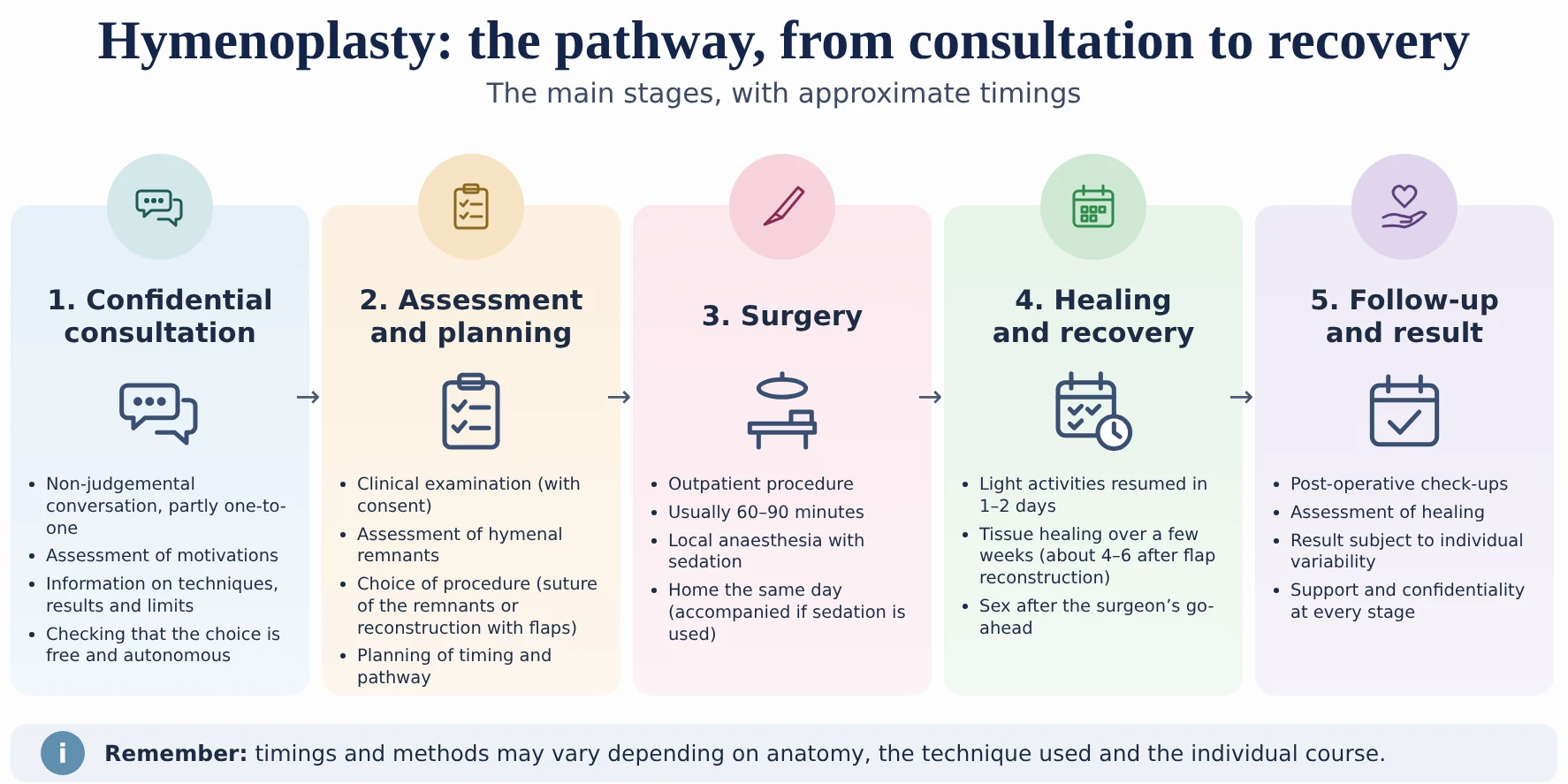
The first consultation is a confidential, non-judgemental conversation. It is used to:
- understand what you want, what your timing is and whether the choice is really yours, with part of the conversation just between the two of us;
- explain what the hymen is and is not, and what reconstruction can realistically achieve;
- carry out, with your consent, a gynaecological examination, to assess the hymenal remnants and understand whether a suture of the remnants is possible or whether small flaps of mucosa are needed;
- show you, by marking them with a surgical skin marker, the flaps of hymen that will be shaped, so that you know in advance how the operation will be carried out;
- discuss alternatives, risks, recovery and check-ups;
- obtain informed consent.
At the end of the consultation you receive the quote.
When not to operate
Waiting, looking into things further or not operating is the right choice if you are a minor, if coercion, threats or fears for your safety emerge, if you expect something from the operation that it cannot give (certain bleeding, a hymen that can be «verified» at an examination) or if the timing does not allow the technique suited to your tissues.
How to choose who to see
Ask whoever examines you which technique they propose and why, how they handle check-ups and what happens if the stitches open. Be wary of anyone who guarantees bleeding or issues virginity certificates.
How the procedure is carried out
In my clinical practice the operation is a day procedure: it usually takes 60–90 minutes, under local anaesthesia combined with sedation managed by the anaesthetist, and you go home the same day, accompanied if sedation was used. Depending on what was decided at the consultation, I stitch the hymenal remnants together or rebuild the fold with small flaps of mucosa. The stitches are internal, on the mucosa, with absorbable sutures.
Risks, complications and possible results
It is a short operation, but it should not be taken lightly. The available studies do not allow reliable percentages to be given, so I list the risks without figures:
- local infection;
- bleeding after the operation;
- reactions to the anaesthesia or sedation;
- reopening of the stitches (wound dehiscence) and incomplete healing: in a Turkish case series, collected through a questionnaire among gynaecologists, it was the complication reported most often;[7]
- excessive narrowing of the vaginal opening, which can make intercourse difficult or painful:[8] it can occur even when the operation is performed correctly;
- persistent pain, painful scars or discomfort during intercourse;
- an anatomical result different from what you expected;
- the need for surgical revision;
- psychological consequences if the operation does not produce the result expected by the family or social context, for example if there is no bleeding.[11]
Even when healing goes well, the reconstructed fold may not behave as you hope during intercourse. Published outcomes describe groups of patients, not what will happen in your case: I tell you this before, not after.
If the stitches come apart or something is not right
If the suture were to reopen or healing did not go as expected, I see you again and we decide together whether a revision is needed, which I perform in the clinic's operating theatre. If there is a correctable defect, the revision has no additional costs: it includes my fee, the anaesthesia, the operating theatre and the materials. The conditions are set out in writing in the quote. The absence of bleeding during intercourse, however, is not a defect that a new operation can correct: this is why we talk about realistic expectations in the first consultation.
After the operation and recovery time
During the operation pain is controlled by the local anaesthesia and the sedation; afterwards, follow the medication prescribed by the anaesthetist. Initial recovery is usually quick, but tissue healing takes a few weeks. As a guide:
- light activities and non-strenuous work: after 1–2 days;
- intimate hygiene: gentle cleansers and lukewarm water, without rubbing;
- tampons: avoid them until the check-up;
- intense sport and exertion: on hold for about 3–4 weeks;
- sexual intercourse: only after I give the go-ahead; after reconstruction with mucosal flaps, usually not before 4–6 weeks, which is an approximate reference and not a deadline; after suturing the remnants, usually not before 4 weeks.
In my clinical practice check-ups are at 15 days, 1 month, 3 months, 6 months and 1 year after the operation, and they are also used to confirm the timing based on the technique and on healing. Contact me straight away if you have a fever, heavy bleeding, pain that increases instead of decreasing, foul-smelling discharge or difficulty passing urine.
Confidentiality and personal data protection
Confidentiality is protected at every stage of the pathway, from booking to follow-up visits. Only your name appears in the diary. Communications are agreed with the patient, using the contact details and methods she has authorised. Medical records are accessible only to authorised staff, while tax documents are prepared in compliance with the law and with data protection rules.
Medical confidentiality does not mean the absence of clinical or tax documentation: a clinical record and an invoice always exist, as the law requires, and they are protected by professional secrecy. How we handle your data is explained in the privacy notice.
The quote: what it depends on
I give you the quote at the end of the consultation, because it depends on what emerges: the technique indicated, the amount and characteristics of the tissue, the expected duration of the operation and the anaesthesia. It includes the operation, anaesthesia and operating theatre, as well as follow-up visits during the first year at no additional cost. The consultation is paid separately; if you then book the operation, its cost is deducted from the total. If there is a correctable defect, the revision has no additional costs: it includes my fee, the anaesthesia, the operating theatre and the materials. The conditions are set out in writing in the quote.
«Prima comprendere» ("Understand first")
People who ask for hymen reconstruction often arrive with a single question: «will it work?». The honest answer is that the operation can rebuild a fold of tissue, but it cannot guarantee what many women hope for, because that expectation rests on an idea of the hymen that medicine has left behind. Before the scalpel comes the time to understand what is being asked of you, by whom, what you risk and what you want.
If you would like to talk about it, the first step is a confidential consultation, with no commitment to surgery.
Frequently asked questions
Does hymenoplasty restore virginity?
No. Virginity is not an anatomical condition that can be diagnosed. Hymenoplasty aims to reconstruct tissue in the hymenal region, but it cannot change a person's sexual history, nor prove it through a medical examination.
Does hymenoplasty guarantee bleeding?
No. Bleeding during sexual intercourse cannot be predicted and is not proof of virginity. No hymen reconstruction technique can guarantee it.
How long does healing take after hymenoplasty?
Initial recovery can be relatively quick, but tissue healing generally takes a few weeks. The timing depends on the technique, the anatomy and how each person heals; when to resume intercourse must be agreed with the surgeon.
Can someone come with me to the consultation?
Yes, you can come alone or with someone you trust. Part of the conversation, in any case, takes place just between the two of us, to make sure the choice is freely made.
What happens if the stitches come apart?
I see you again and we decide together whether a revision is needed, in the clinic's operating theatre. If there is a correctable defect, the revision has no additional costs: it includes my fee, the anaesthesia, the operating theatre and the materials. The conditions are set out in writing in the quote.
I have experienced sexual violence: can the operation help me?
There is no evidence that the operation helps to overcome violence, and in some women it can bring back painful memories. Before talking about surgery we look together at your safety and the support you need. In Italy, 1522, a free line open 24 hours a day, puts you in touch with anti-violence centres.
Annotated scientific bibliography
The sources are divided into three groups: anatomy of the hymen and validity of «virginity tests» (1–2), surgical literature (3–8), ethics, coercion and safety (9–12). The quality of the surgical evidence is limited: these are mainly observational studies or single cases, with procedures, outcomes measured and follow-up that differ from one study to another.
-
Anatomy and virginity testing · International statement
World Health Organization and other United Nations agencies – Eliminating virginity testing: an interagency statement
Source:World Health Organization, 16 October 2018 (WHO/RHR/18.15).
What it covers:
who.intIt states that examining the hymen has no scientific value or clinical indication, that the appearance of the hymen is not a reliable indication of intercourse, and that virginity tests violate human rights.
Why it matters:It is the official reference against the idea of the hymen as proof of virginity, and the reason why no one can promise a «verifiable» result.
-
Anatomy and virginity testing · Narrative review
Moussaoui D, Abdulcadir J, Yaron M – Hymen and virginity: what every paediatrician should know
Source:Journal of Paediatrics and Child Health, 2022;58(3):382–387.
What it covers:
doi:10.1111/jpc.15887It describes the variability of the hymen and its hormonal changes, its capacity to heal, the lack of evidence that sport or tampons damage it, and the fact that bleeding at first intercourse may not occur. It describes virginity tests, virginity certificates and hymenoplasty as unethical practices that can harm health.
Why it matters:It sets out anatomy and myths clearly, with the sources on which the anatomical part of this page is based.
-
Surgical literature · Observational study
van Moorst BR, van Lunsen RHW, van Dijken DKE, Salvatore CM – Backgrounds of women applying for hymen reconstruction, the effects of counselling on myths and misunderstandings about virginity, and the results of hymen reconstruction
Source:The European Journal of Contraception & Reproductive Health Care, 2012;17:93.
What it covers:
doi:10.3109/13625187.2011.64986682 women interviewed at the first visit in two Dutch centres, 68 followed up until their decision: 48% reported sexual violence, and about three in four decided against the operation after counselling. Of the 19 women who had surgery and were contacted again, 17 did not bleed at first intercourse.
Why it matters:It describes a counselling pathway and its outcomes, but without a comparison group: it does not prove a causal effect of counselling.
-
Surgical literature · Case series
Wei SY, Li Q, Li SK, Zhou CD, Li FY, Zhou Y – A new surgical technique of hymenoplasty
Source:International Journal of Gynecology & Obstetrics, 2015;130(1):14–18.
What it covers:
doi:10.1016/j.ijgo.2014.12.009125 patients operated on in Beijing with a single technique; 99 came back for the one-month check-up. Of the 51 who reported intercourse, 28 had bleeding and 47 said they were satisfied.
Why it matters:It shows outcomes different from the Dutch ones; the data after intercourse concern only the patients who reported them by telephone.
-
Surgical literature · Retrospective study
Lahlali A, Sawan D, SidAhmed-Mezi M, Meningaud JP, Hersant B – Hymen restoration: an experience from a Moroccan center
Source:Aesthetic Surgery Journal, 2021;41:NP2053.
What it covers:
doi:10.1093/asj/sjab276529 patients operated on in Morocco between 2010 and 2019, with hymenorrhaphy (42%) or reconstruction with hymenal flaps or, when there were no remnants, vaginal flaps (58%); outcomes collected through visits and interviews after intercourse. The authors note that there is no surgical standard and describe minor complications.
Why it matters:It describes several techniques in a large series, but it is retrospective, without a control group and with outcomes reported by the patients.
-
Surgical literature · Retrospective comparative study
Dogan O, Ucar Kartal D, Aktoz F, Yassa M – Patient satisfaction and bleeding rates following an introital fascial approach for temporary and permanent hymenoplasty techniques: a comparative study
Source:Aesthetic Surgery Journal, 2024.
What it covers:
doi:10.1093/asj/sjae117246 patients operated on in Istanbul between 2015 and 2023: satisfaction with bleeding was 100% with the temporary technique and 78.6% with the permanent one; pain at first intercourse was greater with the temporary technique.
Why it matters:It compares the two approaches directly, but it is not randomised and measures satisfaction without validated questionnaires.
-
Surgical literature · Retrospective study
Cömert E, Caliskan E, Doğan O, Köle E, Saraç ÖD – Hymenoplasty experience: factors associated with dehiscence (hymenoplasty complications)
Source:Acıbadem Üniversitesi Sağlık Bilimleri Dergisi, 2025;16(3):362–366.
What it covers:
doi:10.31067/acusaglik.1633538Using a questionnaire among gynaecologists, it collects data on 968 hymenoplasties performed in private facilities in Turkey: reopening of the stitches was the complication reported most often, followed at a distance by infection, bleeding, pain and pain during intercourse; it analyses the factors associated with reopening.
Why it matters:It is one of the few papers devoted to complications. Its method (data reported by doctors, without standardised follow-up) does not allow a generally valid percentage to be drawn from it.
-
Surgical literature · Case report with review
Pace M, Broquet C, Peter C, Abdulcadir J – Complications of hymenoplasty
Source:BMJ Case Reports, 2023;16(10):e251008.
What it covers:
doi:10.1136/bcr-2022-251008A woman who had hymenorrhaphy a few days before her wedding and was then unable to have intercourse because of narrowing of the vaginal entrance, with pain, treated with a further operation. The authors point out that hymenoplasty is not a standardised technique.
Why it matters:It documents a concrete complication of a suture of the remnants performed a few days before an expected intercourse. A single case does not tell us how often this happens.
-
Ethics, coercion and safety · Ethical and legal analysis
Cook RJ, Dickens BM – Hymen reconstruction: ethical and legal issues
Source:International Journal of Gynecology & Obstetrics, 2009;107(3):266–269.
What it covers:
doi:10.1016/j.ijgo.2009.07.032It examines the arguments of those who oppose the operation (deception, lack of medical necessity, discrimination) and of those who see it as protecting the woman's health, including her mental and social well-being, and her autonomy, in settings where losing her virginity may expose her to violence.
Why it matters:It is the classic reference in the gynaecological literature on the subject. Its legal assessment should be read in the light of country and time: some states have since banned the operation.
-
Ethics, coercion and safety · Survey of doctors
Leye E, Ogbe E, Heyerick M – 'Doing hymen reconstruction': an analysis of perceptions and experiences of Flemish gynaecologists
Source:BMC Women's Health, 2018;18:91.
What it covers:
doi:10.1186/s12905-018-0587-zSurvey of 109 Flemish gynaecologists: 73% had received requests for hymen reconstruction, 81% knew of no guidelines and only 19% of those who had received requests discussed alternatives with their patients.
Why it matters:It shows that the request is common in Europe too, and that information, alternatives and training are often neglected.
-
Ethics, coercion and safety · Government report
Department of Health and Social Care (United Kingdom) – Final report of the expert panel on hymenoplasty: ethical, legal and clinical implications
Source:GOV.UK, 23 December 2021.
What it covers:
gov.ukThe expert panel concludes that the operation has no medical indication and does not guarantee bleeding, and points to strong family pressure, psychological risks and the possibility of triggering traumatic memories in women who have experienced violence; it recommends making it a criminal offence.
Why it matters:It is the broadest institutional analysis of coercion and safety, and the basis for the ban introduced in the United Kingdom.
-
Ethics, coercion and safety · Institutional guidance
Department of Health and Social Care (United Kingdom) – Virginity testing and hymenoplasty: multi-agency guidance
Source:GOV.UK, published on 1 July 2022, the date the ban came into force; updated on 11 August 2025.
What it covers:
gov.ukGuidance for professionals on recognising family pressure, coercive control and forced marriage, speaking to the woman alone and in a safe place, without involving family members as mediators or interpreters, and referring her to protection services.
Why it matters:It describes in practical terms how to protect a woman under pressure. The legal framework is British, but the safeguarding principles apply elsewhere too.
Further reading:
Medically reviewed by Dr Giulio Maria Maggi, Plastic Surgeon — last reviewed:
Article written by Dr Giulio Maria Maggi

Aesthetic Plastic Surgeon – Turin, Asti and Alessandria
Medical Director – Aesthetic Clinic (Turin)
Turin Medical Council (Ordine dei Medici di Torino) no. 20595
Member of AICPE – Italian Association of Aesthetic Plastic Surgery
Expertise and areas of interest
Dr Maggi trained internationally, completing advanced training with Prof. José Guerrero Santos (Guadalajara) and with Prof. Andrew A. Jacono (New York) in the Deep Plane facelift technique.
He focuses in particular on:
- Deep Plane facelift
- Blepharoplasty
- Functional and aesthetic intimate surgery
- Liposculpture and fat grafting (lipofilling)
- Breast surgery
- Body contouring
Clinical approach
Combines scientific rigour with natural results, applying advanced protocols focused on morphological well-being.